
- Active infection, cold sore or skin breakdown in the treatment area
- Isotretinoin within the past six to twelve months
- Pregnancy or breastfeeding (defer, not because of proven laser harm but because of altered tissue response and medico-legal caution)
- Known keloid or hypertrophic scarring tendency
- Uncontrolled autoimmune disease or active thyroid flare
- Recent sun exposure, sunburn or a fresh tan
- Unrealistic expectations about removing volume loss
Assume you are a candidate. What does the calendar actually look like — from consultation through week two?
Treatment Process, Downtime, and Recovery Timeline
Laser under eyes recovery time is the number that decides more bookings than price does. Brides, keynote speakers and anyone with a client-facing week needs this mapped before they commit.
Consultation and skin prep
A proper assessment includes a dermatoscopic look at the under-eye skin, a Fitzpatrick assessment, a medication and allergy review, and photographs under consistent lighting. Consent, a test spot where indicated, and a written plan follow. In the two weeks before treatment: no retinoids in the area, no waxing or chemical peels, no deliberate sun exposure, and no new products that could confuse the picture.
During the procedure
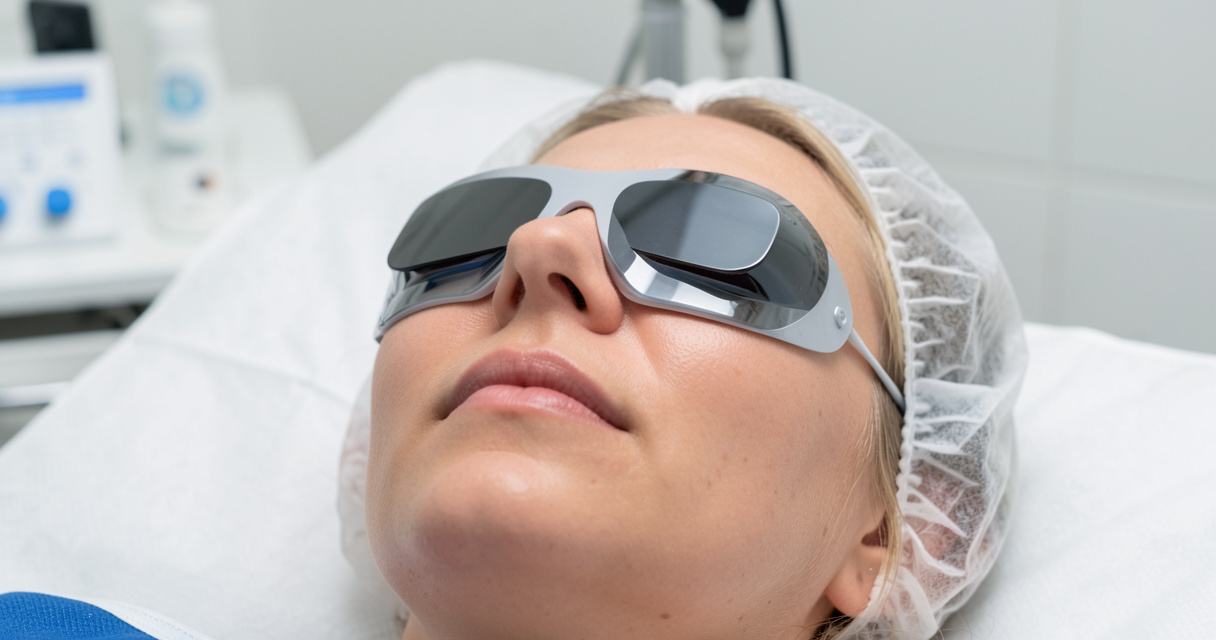
Topical anaesthetic is applied for twenty to forty minutes; corneal shields protect the eyes. Most patients describe the sensation as elastic-band snaps with a cooling stream. An under-eye treatment takes fifteen to thirty minutes. There is no recovery room drama — you walk out, red.
Day-by-day recovery
After a gentle Q-switched session: mild pinkness for a day, occasional light flaking on day two to three, makeup from day two. After pulsed dye: possible purpura for three to seven days — concealer-adjacent, not concealer-fixed. After fractional CO2: significant redness, tightness and pinpoint crusting for five to seven days, with true normalisation closer to day ten to fourteen. Sun protection is non-negotiable for a full four weeks.
| Laser type | Day 1-3 | Day 4-7 | Return to makeup | Return to work |
|---|---|---|---|---|
| Q-switched Nd:YAG | Mild pinkness, slight tightness | Light flaking possible | Day 2 | Day 1-2 |
| Pulsed dye | Swelling, possible purpura | Purpura fading | Day 2, with care | Day 1, or Day 4 if bruising |
| Fractional CO2 | Redness, pinpoint crusting, swelling | Peeling, residual pink | Day 5-7 | Day 5-10 |
| Erbium | Redness, light crusting | Peeling settling | Day 4 | Day 3-5 |
A wedding in six weeks? A fractional CO2 session four weeks out is manageable; one ten days out is a gamble with a heavily photographed outcome. “The single biggest booking error we see,” a London-based oculofacial surgeon told me, “is someone scheduling a resurfacing laser before a work trip and then sitting in a meeting looking like they have been crying for a week.” Pad the calendar. Always.
SECTION_IMAGE_2
Cost, Sessions, and Realistic Results in 2026
Session counts and spacing
Pigment and vascular concerns are cumulative: four to eight Q-switched sessions at two to four week intervals, or three to six pulsed dye sessions at three to four weeks. Resurfacing is the opposite — one to three fractional CO2 sessions spaced six to twelve weeks apart, because the collagen response needs twelve weeks to fully express itself. Anyone promising a single session for pigmented darkness is selling hope, not a plan.
2026 price ranges and packages
Dark circle laser treatment cost varies by city, provider credentials, device generation and whether the plan includes PRP, polynucleotides or filler. Treat the figures below as 2026 bands in major metropolitan markets, quoted in US dollars for comparison.
| Laser type | Typical sessions | Spacing | Estimated 2026 cost | What affects price |
|---|---|---|---|---|
| Q-switched Nd:YAG | 4-8 | 2-4 weeks | $300-$800 per session; $1,200-$4,500 total | City, device, whether the whole orbit or only the hollow is treated |
| Pulsed dye | 3-6 | 3-4 weeks | $400-$900 per session; $1,500-$4,000 total | Physician vs nurse delivery, purpura protocol, vascular mapping |
| Fractional CO2 | 1-3 | 6-12 weeks | $700-$2,200 per session; $1,500-$5,000 total | Fractional density, add-on PRP, anaesthesia, aftercare kit |
| Erbium | 1-3 | 4-6 weeks | $500-$1,300 per session; $1,000-$3,000 total | Depth, area, provider specialty |
What results are realistic?
Not perfection — improvement you can see in daylight and in photographs, typically 30 to 60 percent depending on the driver. Pigment clears gradually and can recur with sun exposure. Vascular darkness responds well but can return with allergy seasons and fatigue. Thin skin thickens over months. Hollowing does not change at all. Maintenance — one session every six to twelve months, plus daily SPF 50 and a topical antioxidant — is part of the plan, not an upsell.
Be wary of package pricing sold before a diagnosis. A six-session package offered at the front desk, before anyone has looked at your skin through a dermatoscope, is a sales structure rather than a treatment plan. The right sequence is assessment, test spot where indicated, then a quote.
Laser vs Fillers, Creams, Peels, Microneedling, and Blepharoplasty
Laser vs filler
The comparison that decides more cases than any other. Laser vs filler for dark circles is not a fair fight, because they treat different anatomy. Laser changes colour and skin quality. Filler restores volume and removes the shadow cast by a tear-trough hollow. If your darkness is structural, filler is the answer and laser is the accessory. If your darkness is pigment or vascular, filler will do nothing and may even highlight the problem. Many patients eventually want both, sequenced — filler first for structure, laser after for surface.
Laser vs creams and peels
Creams with retinoids, vitamin C, niacinamide and tranexamic acid are maintenance tools, not remodelling tools. They can soften superficial pigment over months and support the skin barrier after a procedure. Peels offer gentle superficial exfoliation and modest pigment improvement — useful for the epidermis, largely irrelevant to the dermis or to vessels. Nothing in a jar thickens collagen the way a fractional laser does.
Laser vs microneedling and blepharoplasty
Radiofrequency microneedling is the quiet competitor for thin-skin darkness: it deposits heat at a controlled depth to stimulate collagen with less surface downtime than CO2. It will not clear pigment or close vessels. Blepharoplasty is surgery for structural bags and excess skin — different problem, different solution, and occasionally the only solution. Lower blepharoplasty with fat repositioning can resolve a shadow that no device will touch.
| Option | Best for | Downtime | Duration | Limitations |
|---|---|---|---|---|
| Laser (Q-switched, PDL, CO2, Erbium) | Pigment, vessels, texture, thin skin | 1-10 days depending on device | Months to years, with maintenance | No effect on volume loss; PIH risk in darker skin |
| Dermal filler | Tear-trough hollowing, structural shadow | 2-5 days, possible bruising | 9-18 months | Technique-dependent; risk of lumps, Tyndall effect |
| Creams and serums | Maintenance, superficial pigment | None | Ongoing use required | Cannot remodel collagen or close vessels |
| Chemical peels | Surface pigmentation, dullness | 1-4 days | Weeks to months | Limited depth; irritation risk on thin skin |
| RF microneedling | Thin skin, early laxity, crepey texture | 2-4 days | 6-12 months | No pigment or vascular clearance |
| Blepharoplasty | Structural bags, excess skin | 7-14 days | Years | Surgical risk, cost, irreversibility |
Say it plainly: laser cannot fix volume loss or deep tear-trough hollowing. No wavelength restores fat. If a provider implies otherwise, you have learned something valuable in under five minutes.
How to Choose a Provider and Build a Treatment Plan
Credentials and technology
Look for a board-certified dermatologist or an oculofacial plastic surgeon with documented periorbital laser experience — the specialty matters less than the volume of under-eye work and the honesty of the assessment. Experience is a signal but not a substitute for current technique: Dr. Amiya Prasad has been in practice for over 25 years, according to Prasad Cosmetic Surgery, yet the meaningful question is which device he would use on your skin this month and why. Ask about the platform’s generation, the wavelength, and the clinic’s complication protocol.
Questions to ask before booking
- Which laser, which wavelength, and why this one for my pattern?
- What settings will you use for my Fitzpatrick type?
- Will you do a test spot, and when?
- What downtime should I plan for, day by day?
- What is your complication protocol if I develop PIH?
- How many sessions, spaced how far apart, and what is the total quote?
- What result would make you call this a success — and what would make you stop?
Red flags in marketing
Guaranteed permanent removal. A single session promising to erase hereditary pigment. No test spot offered for darker skin. Pressure to prepay for a package before assessment. Before-and-afters shot under different lighting. Any clinic that cannot name the device on the consent form. The right specialist will happily talk you out of treatment if the diagnosis does not support it — that conversation is worth more than any five-star review.
Walk away if: the plan is sold before your skin is examined, no patch test is offered for Fitzpatrick IV-VI, the practitioner cannot explain what will happen if pigmentation worsens, or you are told laser will fix a hollow.
Frequently asked questions
How many laser sessions are needed for dark circles?
Most plans involve four to eight sessions for pigment, three to six for vascular concerns, or one to three for resurfacing, spaced weeks to months apart. The exact number depends on the laser type, the cause of the darkness and how your skin responds at the two-week review.
Is laser treatment for dark circles safe?
It can be safe when a qualified provider assesses you first and selects settings appropriate to your skin. Risks include redness, swelling, blistering, scarring and post-inflammatory hyperpigmentation, and darker skin tones require extra caution and conservative fluence.
Can laser remove dark circles permanently?
Rarely permanently. Laser improves pigment, vessels, texture and collagen, but genetics, ageing, allergies and hollowing continue to influence how the under-eye looks. Maintenance sessions and adjunct treatments are usually part of a realistic long-term plan.
What laser is best for dark circles under the eyes?
The best laser depends on the cause: Q-switched Nd:YAG for melanin, pulsed dye for visible vessels, fractional CO2 for texture and deep pigment, and Erbium for superficial resurfacing. A diagnosis-first approach matters far more than choosing the most powerful device.
How much does laser for dark circles cost?
In 2026, expect roughly $300 to $900 per session for Q-switched or pulsed dye work, and $700 to $2,200 for fractional CO2, with total plans typically landing between $1,200 and $5,000. City, provider credentials, laser type and combination treatments all move the quote.
What is recovery like after under-eye laser treatment?
Expect redness and swelling for several days, with makeup and work timelines depending on the device. Fractional and resurfacing lasers usually require five to ten days of downtime, while gentle Q-switched or pulsed dye settings may allow a return to work the next day.
Can laser treatment make dark circles worse?
Yes — particularly if the wrong device is used or if post-inflammatory hyperpigmentation develops. A test spot, conservative settings for your skin type, and prompt treatment of any pigment change substantially reduce that risk.
The Verdict
The edit, then. Laser for dark circles works best when the cause is correctly diagnosed as pigment, vessels, thin skin or hollowing — and it is close to useless when it is not. Q-switched Nd:YAG clears melanin, pulsed dye closes vessels, fractional CO2 and Erbium rebuild surface and dermis, and nothing on the menu restores lost volume.
Safety and skin tone decide the plan as much as the diagnosis. Fitzpatrick IV-VI skin can absolutely be treated, but only with 1064 nm wavelengths where possible, conservative fluence, a test spot and a practitioner who tracks post-inflammatory hyperpigmentation rates rather than dismissing the question.
Cost, sessions and downtime vary enormously by device — from a $300 Q-switched session with a day of pinkness to a $2,000 fractional CO2 session with ten days of recovery. Budget for a plan rather than a single appointment, and do not accept a package before anyone has looked at your skin properly. The results are real but gradual: 30 to 60 percent improvement in the right candidate, maintained with sun protection and an annual session.
A qualified provider and a personalized plan matter more than a single viral laser name. The technology is only as good as the diagnosis behind it, and the best clinic in your city is the one willing to tell you that your dark circles are not a laser problem at all.
Before you book, ask what is causing your dark circles — should your next step really be a laser?
- Melanin absorbs short wavelengths — 532 nm, 694 nm — and to a lesser degree 1064 nm. Q-switched lasers fire in nanosecond bursts that shatter pigment granules into particles small enough for the body’s immune cells to clear.
- Hemoglobin absorbs around 585 to 595 nm. Pulsed dye lasers exploit this to close the fine superficial vessels that give some under-eyes a violet or reddish cast.
- Water absorbs 2940 nm (Erbium) and 10,600 nm (CO2) light. These ablative wavelengths vaporize thin columns of tissue, triggering a wound-healing cascade that lays down new collagen over the following eight to twelve weeks.
That third mechanism is the quiet hero of the category. Much under-eye darkness is not colour at all — it is thin skin letting the underlying orbicularis muscle and vascular bed show through. A resurfacing or fractional laser cannot delete a vein, but it can thicken the dermis above it. This is what clinicians mean by collagen remodeling, and it is why results often look better at month three than at week three.
Why dark circles are not one condition
Dermatologists describe at least four distinct patterns, and most faces have two or three running simultaneously: pigmented darkness from melanin deposition, vascular darkness from visible vessels, structural darkness from a shadow cast by a tear-trough hollow or a festoon of puffiness, and thin-skin darkness from genuine dermal atrophy. No single device addresses all four. A fractional CO2 laser will do nothing for volume loss. A pulsed dye laser will do nothing for melanin. This is precisely why the search for the single best laser for dark circles under eyes is the wrong question, and the diagnosis is the right one.
The edit: definitions worth knowing before your consultation. Periorbital hyperpigmentation is the clinical term for darkened skin around the eye. Post-inflammatory hyperpigmentation (PIH) is darkness left behind after the skin is injured — including by a laser. Collagen remodeling is the gradual rebuilding of dermal support that continues for months after treatment. Tear-trough deformity is the hollow that runs from the inner corner of the eye down toward the cheek.
Consider the case that shifted how I think about this category. A 41-year-old creative director had spent four years and roughly $2,000 on pigment-targeting creams and one gentle IPL session. Her darkness was not brown. Under a dermatoscope it read as a dense mat of superficial vessels with a faint violet undertone — a vascular pattern that would have gone on ignoring melanin-focused treatments indefinitely. Four pulsed dye sessions at three-week intervals produced a visible change by week ten. “Patients describe a colour,” her dermatologist told me. “We see a vascular architecture. The two rarely match.”
Safety, too, begins with anatomy. The eyelid is the thinnest skin on the body — roughly 0.5 mm — according to Prasad Cosmetic Surgery, which is why precision and conservative fluence matter more here than anywhere else on the face. Understand that constraint and the device comparison that follows starts to make sense.
SECTION_IMAGE_1
Types of Lasers for Dark Circles: Fractional CO2, Q-Switched Nd:YAG, Pulsed Dye, Erbium
The short answer, before the detail:
- Fractional CO2 laser: improves texture, tightens skin and treats deep pigmentation.
- Q-switched Nd:YAG: targets melanin and discoloration with minimal downtime.
- Pulsed dye laser: reduces visible blood vessels and redness.
- Erbium laser: offers precise superficial resurfacing.
- The best choice depends on whether dark circles are pigmented, vascular or caused by thin skin.
Fractional CO2 laser
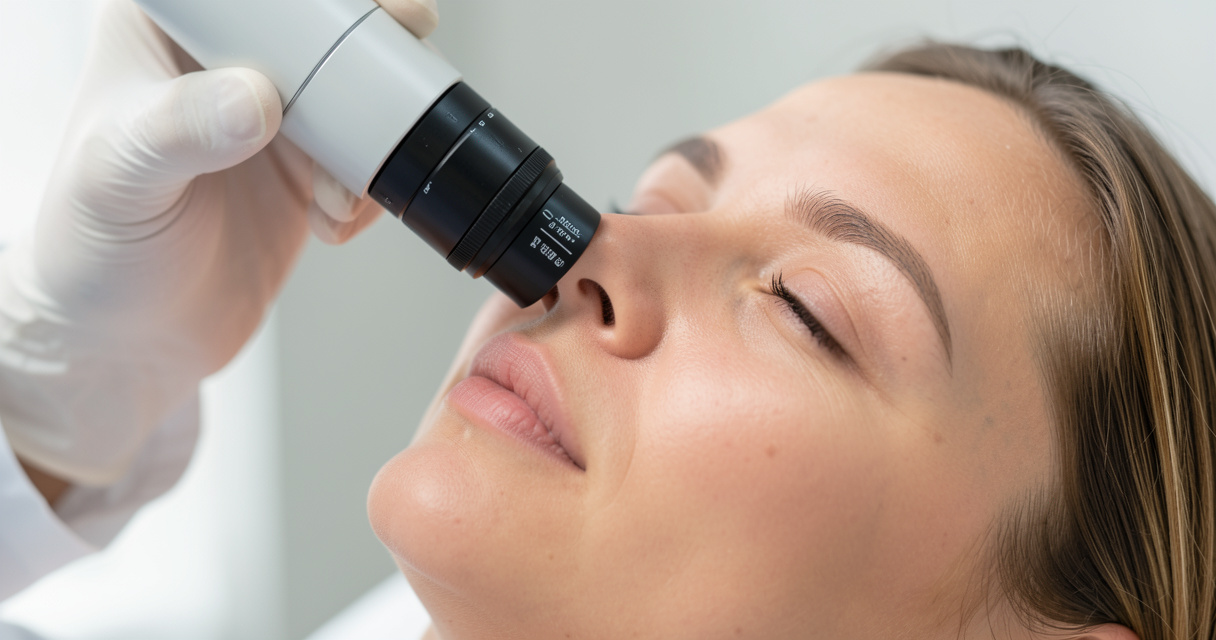
The heavyweight. A fractional CO2 laser for dark circles delivers 10,600 nm light in a dotted pattern, creating microscopic treatment zones that leave bridges of intact skin between them — which is why healing is faster than with fully ablative resurfacing, though still measured in days rather than hours. It is the device most often discussed for deep pigment that sits below the reach of topical actives, and for the crepey, thin texture that makes vessels look more prominent than they are. Expect meaningful collagen response, and expect to clear your calendar.
The caution: periorbital CO2 is unforgiving of imprecise technique. Settings that would be routine on a cheek can create prolonged erythema or, in darker skin, a rim of post-inflammatory hyperpigmentation that takes months to fade.
Q-switched and Nd:YAG lasers
A Q-switched Nd:YAG laser for dark circles is the workhorse of pigment management. Nanosecond pulses at 1064 nm penetrate without being aggressively absorbed by epidermal melanin, which makes them the safer choice for deeper skin tones; the 532 nm setting handles superficial brown pigment but carries more PIH risk. Weekly-to-monthly sessions, modest discomfort, minimal peeling. It is also the device most practitioners reach for when treating laser treatment for under-eye pigmentation caused by sun exposure or chronic rubbing.
One nuance worth carrying into the consultation room: Q-switched lasers clear pigment, but they do not thicken skin. If your darkness is vascular show-through, the improvement will be partial at best.
Pulsed dye laser
The vascular specialist. At 585 to 595 nm, pulsed dye light is absorbed preferentially by oxyhemoglobin, coagulating the fine superficial vessels that create a red, pink or violet under-eye cast. It is the answer for the patient whose darkness intensifies with fatigue, allergies or heat — the vascular signature. Downtime includes a real possibility of temporary purpura, a bruise-like darkening that can last three to seven days. Worth every mile if the diagnosis is right; a waste of money if it is not.
Erbium laser
Erbium:YAG at 2940 nm is the precision instrument of the family — absorbed so strongly by water that it removes tissue in extraordinarily fine increments. For under-eye work it is used for superficial resurfacing and for softening the sharp transition of a pigment border, with a shorter recovery than CO2 and a shallower depth of action. It is not a volume treatment and not a vascular treatment. It is a texture and surface treatment.
| Laser type | Best for | Typical downtime | Sessions | Key risk |
|---|---|---|---|---|
| Fractional CO2 (10,600 nm) | Deep pigment, crepey texture, collagen loss | 5-10 days of redness and flaking | 1-3, spaced 6-12 weeks | Prolonged erythema, PIH in darker skin, scarring with aggressive settings |
| Q-switched Nd:YAG (1064/532 nm) | Epidermal and dermal melanin, sun-driven pigment | 1-3 days of mild pinkness | 4-8, spaced 2-4 weeks | PIH, especially with 532 nm on Fitzpatrick IV-VI |
| Pulsed dye (585-595 nm) | Visible vessels, red-violet vascular darkness | 2-5 days, purpura possible | 3-6, spaced 3-4 weeks | Temporary bruising, rare blistering |
| Erbium (2940 nm) | Superficial resurfacing, pigment border softening | 3-7 days | 1-3, spaced 4-6 weeks | PIH, infection if aftercare slips |
Not every laser belongs under an eye. Devices marketed for the face are frequently used off-label in the periorbital region, and the margin for error is measured in fractions of a millimetre. If a clinic cannot tell you which wavelength it is using, why that wavelength suits your skin type, and what its complication protocol is, that is your answer.
Knowing the devices is half the work. The other half is knowing which of the four dark-circle patterns you are actually presenting — and that requires a diagnosis-first framework.
Which Laser Is Best for Your Dark Circle Type? Pigmentation, Vascular, Thin Skin, Hollows
Here is the framework I would hand to any friend before they book. Match the pattern, then match the device. Everything else is marketing.
Pigmented dark circles
Brown, tea-stained, often extending beyond the orbital rim onto the upper cheek. It worsens with sun and deepens after rubbing. In skin of colour, this pattern is frequently hereditary periorbital hyperpigmentation and runs in families. The best laser for dark circles of this type is typically a Q-switched Nd:YAG at 1064 nm, with fractional CO2 reserved for pigment that sits deeper or coexists with textural change. Sessions are cumulative: expect four to eight, with a maintenance pass every six to twelve months.
Vascular dark circles
Pink, red or violet, thinning toward the inner corner, worse when tired, congested or overheated. Pulsed dye is the first-line laser; a long-pulsed 1064 nm Nd:YAG can complement it for slightly larger vessels. The clinical vignette that repeats in every good practice: a patient treated for pigment for two years who was vascular all along. If your darkness blushes when you press it, that is a signal worth voicing.
Thin skin and visible veins
The hardest to treat and the most rewarding to get right. The skin is translucent rather than discoloured, so the darkness is structural show-through. Non-ablative fractional resurfacing, fractional CO2 at conservative settings, or radiofrequency microneedling will build dermal thickness over months. No laser can delete the vein itself. What it can do is put more dermis between the vein and the light.
Hollowing and tear-trough deformity
This is the one where laser is often the wrong instrument entirely. A hollow creates a shadow, and a shadow cannot be lasered away. Hyaluronic acid filler placed by an experienced oculofacial or dermatologic injector, or in selected cases lower blepharoplasty, addresses the cause. At most, laser prepares the canvas by improving skin quality around the hollow. Be wary of anyone who proposes six CO2 sessions for a shadow.
| Dark circle type | Likely driver | Laser or adjunct option | What laser cannot fix |
|---|---|---|---|
| Pigmented | Melanin, sun, heredity, rubbing | Q-switched Nd:YAG 1064 nm; fractional CO2 for deeper pigment | Hollows, visible vessels, volume loss |
| Vascular | Superficial vessels, congestion, allergies | Pulsed dye; long-pulsed Nd:YAG as adjunct | Structural shadows, pigment |
| Thin skin | Dermal atrophy, translucent skin | Non-ablative or fractional resurfacing; RF microneedling | Deep hollows, active allergy-driven darkness |
| Hollowing | Tear-trough deformity, fat loss, bone structure | Filler or surgery primary; laser only as adjunct | The shadow itself |
Self-assessment before you book
- Does the darkness read brown in daylight, or pink and violet?
- Does it lighten when you gently press the skin, suggesting a vascular component?
- Is there a visible hollow running from the inner corner toward the cheek?
- Is there puffiness that casts a shadow in overhead light?
- Do you have hay fever, sinus congestion or a chronic rubbing habit?
- Has it been present since childhood, or did it appear in the last five years?
- Does it worsen with poor sleep, salt, alcohol or screen time?
Answer those honestly and you will walk into a consultation with something most patients never have: a hypothesis. The next question is whether your skin can safely be treated at all.
Who Is a Good Candidate? Skin Tone Safety, Risks, and Red Flags
Fitzpatrick skin types IV-VI
The single most important safety conversation in this field concerns melanin-rich skin. In Fitzpatrick IV, V and VI, the epidermis itself contains substantial melanin, which competes with the target pigment for laser energy. Overheat the epidermis and you get post-inflammatory hyperpigmentation — a new, deeper ring of darkness precisely where you were trying to remove one.
Laser for dark circles on brown skin is entirely feasible, and the technique is well established. Principles: 1064 nm over 532 nm wherever possible, nanosecond or picosecond pulses, lower fluence, longer intervals, aggressive cooling, and a mandatory test spot in a discreet area at least two weeks before the first full treatment. Many practitioners will also pretreat with a tyrosinase inhibitor for two to four weeks. The discerning patient asks for the test spot; the excellent clinic offers it before being asked.
History of keloids, infections, or isotretinoin
Keloid or hypertrophic scarring history is a relative contraindication for ablative resurfacing, and the eyelid is not a place to test the theory. Recent isotretinoin use — commonly six to twelve months of clearance depending on the practitioner and dose — alters wound healing and is generally a reason to wait. Active infection, eczema, rosacea flare, conjunctivitis or blepharitis in the treatment zone means rescheduling, not persevering.
When to pause and see a doctor
Some darkness is a medical signal. Persistent unilateral shadowing, a new mole, itching, bleeding, changing pigmentation or darkness that appears suddenly in adulthood warrants a physician’s assessment before any cosmetic device is considered. Thyroid disease, autoimmune conditions and pregnancy all change the risk calculus. Laser is an elective procedure; it can always wait a month.
PIH is the risk to take seriously. It is more common in darker skin, more common with higher fluence, more common with ablative devices, and more common when aftercare slips. Ask directly: what is your rate of post-inflammatory hyperpigmentation in Fitzpatrick IV-VI patients, and how do you treat it if it occurs?
- Active infection, cold sore or skin breakdown in the treatment area
- Isotretinoin within the past six to twelve months
- Pregnancy or breastfeeding (defer, not because of proven laser harm but because of altered tissue response and medico-legal caution)
- Known keloid or hypertrophic scarring tendency
- Uncontrolled autoimmune disease or active thyroid flare
- Recent sun exposure, sunburn or a fresh tan
- Unrealistic expectations about removing volume loss
Assume you are a candidate. What does the calendar actually look like — from consultation through week two?
Treatment Process, Downtime, and Recovery Timeline
Laser under eyes recovery time is the number that decides more bookings than price does. Brides, keynote speakers and anyone with a client-facing week needs this mapped before they commit.
Consultation and skin prep
A proper assessment includes a dermatoscopic look at the under-eye skin, a Fitzpatrick assessment, a medication and allergy review, and photographs under consistent lighting. Consent, a test spot where indicated, and a written plan follow. In the two weeks before treatment: no retinoids in the area, no waxing or chemical peels, no deliberate sun exposure, and no new products that could confuse the picture.
During the procedure
Topical anaesthetic is applied for twenty to forty minutes; corneal shields protect the eyes. Most patients describe the sensation as elastic-band snaps with a cooling stream. An under-eye treatment takes fifteen to thirty minutes. There is no recovery room drama — you walk out, red.
Day-by-day recovery
After a gentle Q-switched session: mild pinkness for a day, occasional light flaking on day two to three, makeup from day two. After pulsed dye: possible purpura for three to seven days — concealer-adjacent, not concealer-fixed. After fractional CO2: significant redness, tightness and pinpoint crusting for five to seven days, with true normalisation closer to day ten to fourteen. Sun protection is non-negotiable for a full four weeks.
| Laser type | Day 1-3 | Day 4-7 | Return to makeup | Return to work |
|---|---|---|---|---|
| Q-switched Nd:YAG | Mild pinkness, slight tightness | Light flaking possible | Day 2 | Day 1-2 |
| Pulsed dye | Swelling, possible purpura | Purpura fading | Day 2, with care | Day 1, or Day 4 if bruising |
| Fractional CO2 | Redness, pinpoint crusting, swelling | Peeling, residual pink | Day 5-7 | Day 5-10 |
| Erbium | Redness, light crusting | Peeling settling | Day 4 | Day 3-5 |
A wedding in six weeks? A fractional CO2 session four weeks out is manageable; one ten days out is a gamble with a heavily photographed outcome. “The single biggest booking error we see,” a London-based oculofacial surgeon told me, “is someone scheduling a resurfacing laser before a work trip and then sitting in a meeting looking like they have been crying for a week.” Pad the calendar. Always.
SECTION_IMAGE_2
Cost, Sessions, and Realistic Results in 2026
Session counts and spacing
Pigment and vascular concerns are cumulative: four to eight Q-switched sessions at two to four week intervals, or three to six pulsed dye sessions at three to four weeks. Resurfacing is the opposite — one to three fractional CO2 sessions spaced six to twelve weeks apart, because the collagen response needs twelve weeks to fully express itself. Anyone promising a single session for pigmented darkness is selling hope, not a plan.
2026 price ranges and packages
Dark circle laser treatment cost varies by city, provider credentials, device generation and whether the plan includes PRP, polynucleotides or filler. Treat the figures below as 2026 bands in major metropolitan markets, quoted in US dollars for comparison.
| Laser type | Typical sessions | Spacing | Estimated 2026 cost | What affects price |
|---|---|---|---|---|
| Q-switched Nd:YAG | 4-8 | 2-4 weeks | $300-$800 per session; $1,200-$4,500 total | City, device, whether the whole orbit or only the hollow is treated |
| Pulsed dye | 3-6 | 3-4 weeks | $400-$900 per session; $1,500-$4,000 total | Physician vs nurse delivery, purpura protocol, vascular mapping |
| Fractional CO2 | 1-3 | 6-12 weeks | $700-$2,200 per session; $1,500-$5,000 total | Fractional density, add-on PRP, anaesthesia, aftercare kit |
| Erbium | 1-3 | 4-6 weeks | $500-$1,300 per session; $1,000-$3,000 total | Depth, area, provider specialty |
What results are realistic?
Not perfection — improvement you can see in daylight and in photographs, typically 30 to 60 percent depending on the driver. Pigment clears gradually and can recur with sun exposure. Vascular darkness responds well but can return with allergy seasons and fatigue. Thin skin thickens over months. Hollowing does not change at all. Maintenance — one session every six to twelve months, plus daily SPF 50 and a topical antioxidant — is part of the plan, not an upsell.
Be wary of package pricing sold before a diagnosis. A six-session package offered at the front desk, before anyone has looked at your skin through a dermatoscope, is a sales structure rather than a treatment plan. The right sequence is assessment, test spot where indicated, then a quote.
Laser vs Fillers, Creams, Peels, Microneedling, and Blepharoplasty
Laser vs filler
The comparison that decides more cases than any other. Laser vs filler for dark circles is not a fair fight, because they treat different anatomy. Laser changes colour and skin quality. Filler restores volume and removes the shadow cast by a tear-trough hollow. If your darkness is structural, filler is the answer and laser is the accessory. If your darkness is pigment or vascular, filler will do nothing and may even highlight the problem. Many patients eventually want both, sequenced — filler first for structure, laser after for surface.
Laser vs creams and peels
Creams with retinoids, vitamin C, niacinamide and tranexamic acid are maintenance tools, not remodelling tools. They can soften superficial pigment over months and support the skin barrier after a procedure. Peels offer gentle superficial exfoliation and modest pigment improvement — useful for the epidermis, largely irrelevant to the dermis or to vessels. Nothing in a jar thickens collagen the way a fractional laser does.
Laser vs microneedling and blepharoplasty
Radiofrequency microneedling is the quiet competitor for thin-skin darkness: it deposits heat at a controlled depth to stimulate collagen with less surface downtime than CO2. It will not clear pigment or close vessels. Blepharoplasty is surgery for structural bags and excess skin — different problem, different solution, and occasionally the only solution. Lower blepharoplasty with fat repositioning can resolve a shadow that no device will touch.
| Option | Best for | Downtime | Duration | Limitations |
|---|---|---|---|---|
| Laser (Q-switched, PDL, CO2, Erbium) | Pigment, vessels, texture, thin skin | 1-10 days depending on device | Months to years, with maintenance | No effect on volume loss; PIH risk in darker skin |
| Dermal filler | Tear-trough hollowing, structural shadow | 2-5 days, possible bruising | 9-18 months | Technique-dependent; risk of lumps, Tyndall effect |
| Creams and serums | Maintenance, superficial pigment | None | Ongoing use required | Cannot remodel collagen or close vessels |
| Chemical peels | Surface pigmentation, dullness | 1-4 days | Weeks to months | Limited depth; irritation risk on thin skin |
| RF microneedling | Thin skin, early laxity, crepey texture | 2-4 days | 6-12 months | No pigment or vascular clearance |
| Blepharoplasty | Structural bags, excess skin | 7-14 days | Years | Surgical risk, cost, irreversibility |
Say it plainly: laser cannot fix volume loss or deep tear-trough hollowing. No wavelength restores fat. If a provider implies otherwise, you have learned something valuable in under five minutes.
How to Choose a Provider and Build a Treatment Plan
Credentials and technology
Look for a board-certified dermatologist or an oculofacial plastic surgeon with documented periorbital laser experience — the specialty matters less than the volume of under-eye work and the honesty of the assessment. Experience is a signal but not a substitute for current technique: Dr. Amiya Prasad has been in practice for over 25 years, according to Prasad Cosmetic Surgery, yet the meaningful question is which device he would use on your skin this month and why. Ask about the platform’s generation, the wavelength, and the clinic’s complication protocol.
Questions to ask before booking
- Which laser, which wavelength, and why this one for my pattern?
- What settings will you use for my Fitzpatrick type?
- Will you do a test spot, and when?
- What downtime should I plan for, day by day?
- What is your complication protocol if I develop PIH?
- How many sessions, spaced how far apart, and what is the total quote?
- What result would make you call this a success — and what would make you stop?
Red flags in marketing
Guaranteed permanent removal. A single session promising to erase hereditary pigment. No test spot offered for darker skin. Pressure to prepay for a package before assessment. Before-and-afters shot under different lighting. Any clinic that cannot name the device on the consent form. The right specialist will happily talk you out of treatment if the diagnosis does not support it — that conversation is worth more than any five-star review.
Walk away if: the plan is sold before your skin is examined, no patch test is offered for Fitzpatrick IV-VI, the practitioner cannot explain what will happen if pigmentation worsens, or you are told laser will fix a hollow.
Frequently asked questions
How many laser sessions are needed for dark circles?
Most plans involve four to eight sessions for pigment, three to six for vascular concerns, or one to three for resurfacing, spaced weeks to months apart. The exact number depends on the laser type, the cause of the darkness and how your skin responds at the two-week review.
Is laser treatment for dark circles safe?
It can be safe when a qualified provider assesses you first and selects settings appropriate to your skin. Risks include redness, swelling, blistering, scarring and post-inflammatory hyperpigmentation, and darker skin tones require extra caution and conservative fluence.
Can laser remove dark circles permanently?
Rarely permanently. Laser improves pigment, vessels, texture and collagen, but genetics, ageing, allergies and hollowing continue to influence how the under-eye looks. Maintenance sessions and adjunct treatments are usually part of a realistic long-term plan.
What laser is best for dark circles under the eyes?
The best laser depends on the cause: Q-switched Nd:YAG for melanin, pulsed dye for visible vessels, fractional CO2 for texture and deep pigment, and Erbium for superficial resurfacing. A diagnosis-first approach matters far more than choosing the most powerful device.
How much does laser for dark circles cost?
In 2026, expect roughly $300 to $900 per session for Q-switched or pulsed dye work, and $700 to $2,200 for fractional CO2, with total plans typically landing between $1,200 and $5,000. City, provider credentials, laser type and combination treatments all move the quote.
What is recovery like after under-eye laser treatment?
Expect redness and swelling for several days, with makeup and work timelines depending on the device. Fractional and resurfacing lasers usually require five to ten days of downtime, while gentle Q-switched or pulsed dye settings may allow a return to work the next day.
Can laser treatment make dark circles worse?
Yes — particularly if the wrong device is used or if post-inflammatory hyperpigmentation develops. A test spot, conservative settings for your skin type, and prompt treatment of any pigment change substantially reduce that risk.
The Verdict
The edit, then. Laser for dark circles works best when the cause is correctly diagnosed as pigment, vessels, thin skin or hollowing — and it is close to useless when it is not. Q-switched Nd:YAG clears melanin, pulsed dye closes vessels, fractional CO2 and Erbium rebuild surface and dermis, and nothing on the menu restores lost volume.
Safety and skin tone decide the plan as much as the diagnosis. Fitzpatrick IV-VI skin can absolutely be treated, but only with 1064 nm wavelengths where possible, conservative fluence, a test spot and a practitioner who tracks post-inflammatory hyperpigmentation rates rather than dismissing the question.
Cost, sessions and downtime vary enormously by device — from a $300 Q-switched session with a day of pinkness to a $2,000 fractional CO2 session with ten days of recovery. Budget for a plan rather than a single appointment, and do not accept a package before anyone has looked at your skin properly. The results are real but gradual: 30 to 60 percent improvement in the right candidate, maintained with sun protection and an annual session.
A qualified provider and a personalized plan matter more than a single viral laser name. The technology is only as good as the diagnosis behind it, and the best clinic in your city is the one willing to tell you that your dark circles are not a laser problem at all.
Before you book, ask what is causing your dark circles — should your next step really be a laser?
Reading time: 20 min
Key takeaways
- Laser for dark circles is not one treatment. Fractional CO2, Q-switched Nd:YAG, pulsed dye and Erbium lasers do entirely different jobs, and the right choice depends on whether the darkness is pigment, vessels, thin skin or hollowing.
- Diagnosis beats intensity. The strongest laser on the menu is rarely the best one under an eyelid that measures roughly 0.5 mm thick.
- Skin tone changes the plan. Fitzpatrick IV-VI skin carries a documented risk of post-inflammatory hyperpigmentation, so conservative settings, a test spot and a 1064 nm wavelength matter more than speed.
- Expect a range, not a promise. In 2026 most plans run three to six sessions, cost roughly $1,200 to $4,500 in total depending on city and device, and deliver gradual rather than permanent change.
What if the best laser for dark circles is not the strongest one, but the one matched to your actual cause? That question is the whole game. In a decade of sitting in on consultations from Harley Street to Beverly Hills and Seoul’s Apgujeong district, the pattern is remarkably consistent: people arrive having spent years on eye creams and concealers, and they want one straight answer about whether an under-eye laser treatment can genuinely change what they see in the mirror.
The honest answer is layered. Laser for dark circles works — sometimes spectacularly — but only when the device is aimed at the structure actually causing the shadow. Aim it at the wrong layer and you get a costly, uncomfortable detour, occasionally with new pigmentation as a souvenir. This guide maps the four types of dark circles to the laser families that address them, gives transparent 2026 cost and downtime data, and explains exactly when dark circle laser treatment is the wrong first move.
What Laser for Dark Circles Actually Does
On a grey Tuesday in Marylebone, a patient in her late thirties emptied a canvas bag onto the consulting desk: seven eye creams, two concealers, a jade roller and a decade of photographs. The darkness had not moved. What had moved was her patience.
This is the moment most people arrive at under-eye laser treatment — not as a first experiment, but as a correction. And the first thing worth understanding is that a laser does not remove dark circles the way a cleanser removes makeup. It does something far more specific, and that specificity is why results range from transformative to nonexistent.
How focused light targets pigment, vessels, and collagen
Every laser works through a principle called selective photothermolysis: light of a chosen wavelength is absorbed by a chosen target, called a chromophore, while surrounding tissue is spared. Under the eye, there are three relevant targets.
- Melanin absorbs short wavelengths — 532 nm, 694 nm — and to a lesser degree 1064 nm. Q-switched lasers fire in nanosecond bursts that shatter pigment granules into particles small enough for the body’s immune cells to clear.
- Hemoglobin absorbs around 585 to 595 nm. Pulsed dye lasers exploit this to close the fine superficial vessels that give some under-eyes a violet or reddish cast.
- Water absorbs 2940 nm (Erbium) and 10,600 nm (CO2) light. These ablative wavelengths vaporize thin columns of tissue, triggering a wound-healing cascade that lays down new collagen over the following eight to twelve weeks.
That third mechanism is the quiet hero of the category. Much under-eye darkness is not colour at all — it is thin skin letting the underlying orbicularis muscle and vascular bed show through. A resurfacing or fractional laser cannot delete a vein, but it can thicken the dermis above it. This is what clinicians mean by collagen remodeling, and it is why results often look better at month three than at week three.
Why dark circles are not one condition
Dermatologists describe at least four distinct patterns, and most faces have two or three running simultaneously: pigmented darkness from melanin deposition, vascular darkness from visible vessels, structural darkness from a shadow cast by a tear-trough hollow or a festoon of puffiness, and thin-skin darkness from genuine dermal atrophy. No single device addresses all four. A fractional CO2 laser will do nothing for volume loss. A pulsed dye laser will do nothing for melanin. This is precisely why the search for the single best laser for dark circles under eyes is the wrong question, and the diagnosis is the right one.
The edit: definitions worth knowing before your consultation. Periorbital hyperpigmentation is the clinical term for darkened skin around the eye. Post-inflammatory hyperpigmentation (PIH) is darkness left behind after the skin is injured — including by a laser. Collagen remodeling is the gradual rebuilding of dermal support that continues for months after treatment. Tear-trough deformity is the hollow that runs from the inner corner of the eye down toward the cheek.
Consider the case that shifted how I think about this category. A 41-year-old creative director had spent four years and roughly $2,000 on pigment-targeting creams and one gentle IPL session. Her darkness was not brown. Under a dermatoscope it read as a dense mat of superficial vessels with a faint violet undertone — a vascular pattern that would have gone on ignoring melanin-focused treatments indefinitely. Four pulsed dye sessions at three-week intervals produced a visible change by week ten. “Patients describe a colour,” her dermatologist told me. “We see a vascular architecture. The two rarely match.”
Safety, too, begins with anatomy. The eyelid is the thinnest skin on the body — roughly 0.5 mm — according to Prasad Cosmetic Surgery, which is why precision and conservative fluence matter more here than anywhere else on the face. Understand that constraint and the device comparison that follows starts to make sense.
SECTION_IMAGE_1
Types of Lasers for Dark Circles: Fractional CO2, Q-Switched Nd:YAG, Pulsed Dye, Erbium
The short answer, before the detail:
- Fractional CO2 laser: improves texture, tightens skin and treats deep pigmentation.
- Q-switched Nd:YAG: targets melanin and discoloration with minimal downtime.
- Pulsed dye laser: reduces visible blood vessels and redness.
- Erbium laser: offers precise superficial resurfacing.
- The best choice depends on whether dark circles are pigmented, vascular or caused by thin skin.
Fractional CO2 laser
The heavyweight. A fractional CO2 laser for dark circles delivers 10,600 nm light in a dotted pattern, creating microscopic treatment zones that leave bridges of intact skin between them — which is why healing is faster than with fully ablative resurfacing, though still measured in days rather than hours. It is the device most often discussed for deep pigment that sits below the reach of topical actives, and for the crepey, thin texture that makes vessels look more prominent than they are. Expect meaningful collagen response, and expect to clear your calendar.
The caution: periorbital CO2 is unforgiving of imprecise technique. Settings that would be routine on a cheek can create prolonged erythema or, in darker skin, a rim of post-inflammatory hyperpigmentation that takes months to fade.
Q-switched and Nd:YAG lasers
A Q-switched Nd:YAG laser for dark circles is the workhorse of pigment management. Nanosecond pulses at 1064 nm penetrate without being aggressively absorbed by epidermal melanin, which makes them the safer choice for deeper skin tones; the 532 nm setting handles superficial brown pigment but carries more PIH risk. Weekly-to-monthly sessions, modest discomfort, minimal peeling. It is also the device most practitioners reach for when treating laser treatment for under-eye pigmentation caused by sun exposure or chronic rubbing.
One nuance worth carrying into the consultation room: Q-switched lasers clear pigment, but they do not thicken skin. If your darkness is vascular show-through, the improvement will be partial at best.
Pulsed dye laser
The vascular specialist. At 585 to 595 nm, pulsed dye light is absorbed preferentially by oxyhemoglobin, coagulating the fine superficial vessels that create a red, pink or violet under-eye cast. It is the answer for the patient whose darkness intensifies with fatigue, allergies or heat — the vascular signature. Downtime includes a real possibility of temporary purpura, a bruise-like darkening that can last three to seven days. Worth every mile if the diagnosis is right; a waste of money if it is not.
Erbium laser
Erbium:YAG at 2940 nm is the precision instrument of the family — absorbed so strongly by water that it removes tissue in extraordinarily fine increments. For under-eye work it is used for superficial resurfacing and for softening the sharp transition of a pigment border, with a shorter recovery than CO2 and a shallower depth of action. It is not a volume treatment and not a vascular treatment. It is a texture and surface treatment.
| Laser type | Best for | Typical downtime | Sessions | Key risk |
|---|---|---|---|---|
| Fractional CO2 (10,600 nm) | Deep pigment, crepey texture, collagen loss | 5-10 days of redness and flaking | 1-3, spaced 6-12 weeks | Prolonged erythema, PIH in darker skin, scarring with aggressive settings |
| Q-switched Nd:YAG (1064/532 nm) | Epidermal and dermal melanin, sun-driven pigment | 1-3 days of mild pinkness | 4-8, spaced 2-4 weeks | PIH, especially with 532 nm on Fitzpatrick IV-VI |
| Pulsed dye (585-595 nm) | Visible vessels, red-violet vascular darkness | 2-5 days, purpura possible | 3-6, spaced 3-4 weeks | Temporary bruising, rare blistering |
| Erbium (2940 nm) | Superficial resurfacing, pigment border softening | 3-7 days | 1-3, spaced 4-6 weeks | PIH, infection if aftercare slips |
Not every laser belongs under an eye. Devices marketed for the face are frequently used off-label in the periorbital region, and the margin for error is measured in fractions of a millimetre. If a clinic cannot tell you which wavelength it is using, why that wavelength suits your skin type, and what its complication protocol is, that is your answer.
Knowing the devices is half the work. The other half is knowing which of the four dark-circle patterns you are actually presenting — and that requires a diagnosis-first framework.
Which Laser Is Best for Your Dark Circle Type? Pigmentation, Vascular, Thin Skin, Hollows
Here is the framework I would hand to any friend before they book. Match the pattern, then match the device. Everything else is marketing.
Pigmented dark circles
Brown, tea-stained, often extending beyond the orbital rim onto the upper cheek. It worsens with sun and deepens after rubbing. In skin of colour, this pattern is frequently hereditary periorbital hyperpigmentation and runs in families. The best laser for dark circles of this type is typically a Q-switched Nd:YAG at 1064 nm, with fractional CO2 reserved for pigment that sits deeper or coexists with textural change. Sessions are cumulative: expect four to eight, with a maintenance pass every six to twelve months.
Vascular dark circles
Pink, red or violet, thinning toward the inner corner, worse when tired, congested or overheated. Pulsed dye is the first-line laser; a long-pulsed 1064 nm Nd:YAG can complement it for slightly larger vessels. The clinical vignette that repeats in every good practice: a patient treated for pigment for two years who was vascular all along. If your darkness blushes when you press it, that is a signal worth voicing.
Thin skin and visible veins
The hardest to treat and the most rewarding to get right. The skin is translucent rather than discoloured, so the darkness is structural show-through. Non-ablative fractional resurfacing, fractional CO2 at conservative settings, or radiofrequency microneedling will build dermal thickness over months. No laser can delete the vein itself. What it can do is put more dermis between the vein and the light.
Hollowing and tear-trough deformity
This is the one where laser is often the wrong instrument entirely. A hollow creates a shadow, and a shadow cannot be lasered away. Hyaluronic acid filler placed by an experienced oculofacial or dermatologic injector, or in selected cases lower blepharoplasty, addresses the cause. At most, laser prepares the canvas by improving skin quality around the hollow. Be wary of anyone who proposes six CO2 sessions for a shadow.
| Dark circle type | Likely driver | Laser or adjunct option | What laser cannot fix |
|---|---|---|---|
| Pigmented | Melanin, sun, heredity, rubbing | Q-switched Nd:YAG 1064 nm; fractional CO2 for deeper pigment | Hollows, visible vessels, volume loss |
| Vascular | Superficial vessels, congestion, allergies | Pulsed dye; long-pulsed Nd:YAG as adjunct | Structural shadows, pigment |
| Thin skin | Dermal atrophy, translucent skin | Non-ablative or fractional resurfacing; RF microneedling | Deep hollows, active allergy-driven darkness |
| Hollowing | Tear-trough deformity, fat loss, bone structure | Filler or surgery primary; laser only as adjunct | The shadow itself |
Self-assessment before you book
- Does the darkness read brown in daylight, or pink and violet?
- Does it lighten when you gently press the skin, suggesting a vascular component?
- Is there a visible hollow running from the inner corner toward the cheek?
- Is there puffiness that casts a shadow in overhead light?
- Do you have hay fever, sinus congestion or a chronic rubbing habit?
- Has it been present since childhood, or did it appear in the last five years?
- Does it worsen with poor sleep, salt, alcohol or screen time?
Answer those honestly and you will walk into a consultation with something most patients never have: a hypothesis. The next question is whether your skin can safely be treated at all.
Who Is a Good Candidate? Skin Tone Safety, Risks, and Red Flags
Fitzpatrick skin types IV-VI
The single most important safety conversation in this field concerns melanin-rich skin. In Fitzpatrick IV, V and VI, the epidermis itself contains substantial melanin, which competes with the target pigment for laser energy. Overheat the epidermis and you get post-inflammatory hyperpigmentation — a new, deeper ring of darkness precisely where you were trying to remove one.
Laser for dark circles on brown skin is entirely feasible, and the technique is well established. Principles: 1064 nm over 532 nm wherever possible, nanosecond or picosecond pulses, lower fluence, longer intervals, aggressive cooling, and a mandatory test spot in a discreet area at least two weeks before the first full treatment. Many practitioners will also pretreat with a tyrosinase inhibitor for two to four weeks. The discerning patient asks for the test spot; the excellent clinic offers it before being asked.
History of keloids, infections, or isotretinoin
Keloid or hypertrophic scarring history is a relative contraindication for ablative resurfacing, and the eyelid is not a place to test the theory. Recent isotretinoin use — commonly six to twelve months of clearance depending on the practitioner and dose — alters wound healing and is generally a reason to wait. Active infection, eczema, rosacea flare, conjunctivitis or blepharitis in the treatment zone means rescheduling, not persevering.
When to pause and see a doctor
Some darkness is a medical signal. Persistent unilateral shadowing, a new mole, itching, bleeding, changing pigmentation or darkness that appears suddenly in adulthood warrants a physician’s assessment before any cosmetic device is considered. Thyroid disease, autoimmune conditions and pregnancy all change the risk calculus. Laser is an elective procedure; it can always wait a month.
PIH is the risk to take seriously. It is more common in darker skin, more common with higher fluence, more common with ablative devices, and more common when aftercare slips. Ask directly: what is your rate of post-inflammatory hyperpigmentation in Fitzpatrick IV-VI patients, and how do you treat it if it occurs?
- Active infection, cold sore or skin breakdown in the treatment area
- Isotretinoin within the past six to twelve months
- Pregnancy or breastfeeding (defer, not because of proven laser harm but because of altered tissue response and medico-legal caution)
- Known keloid or hypertrophic scarring tendency
- Uncontrolled autoimmune disease or active thyroid flare
- Recent sun exposure, sunburn or a fresh tan
- Unrealistic expectations about removing volume loss
Assume you are a candidate. What does the calendar actually look like — from consultation through week two?
Treatment Process, Downtime, and Recovery Timeline
Laser under eyes recovery time is the number that decides more bookings than price does. Brides, keynote speakers and anyone with a client-facing week needs this mapped before they commit.
Consultation and skin prep
A proper assessment includes a dermatoscopic look at the under-eye skin, a Fitzpatrick assessment, a medication and allergy review, and photographs under consistent lighting. Consent, a test spot where indicated, and a written plan follow. In the two weeks before treatment: no retinoids in the area, no waxing or chemical peels, no deliberate sun exposure, and no new products that could confuse the picture.
During the procedure
Topical anaesthetic is applied for twenty to forty minutes; corneal shields protect the eyes. Most patients describe the sensation as elastic-band snaps with a cooling stream. An under-eye treatment takes fifteen to thirty minutes. There is no recovery room drama — you walk out, red.
Day-by-day recovery
After a gentle Q-switched session: mild pinkness for a day, occasional light flaking on day two to three, makeup from day two. After pulsed dye: possible purpura for three to seven days — concealer-adjacent, not concealer-fixed. After fractional CO2: significant redness, tightness and pinpoint crusting for five to seven days, with true normalisation closer to day ten to fourteen. Sun protection is non-negotiable for a full four weeks.
| Laser type | Day 1-3 | Day 4-7 | Return to makeup | Return to work |
|---|---|---|---|---|
| Q-switched Nd:YAG | Mild pinkness, slight tightness | Light flaking possible | Day 2 | Day 1-2 |
| Pulsed dye | Swelling, possible purpura | Purpura fading | Day 2, with care | Day 1, or Day 4 if bruising |
| Fractional CO2 | Redness, pinpoint crusting, swelling | Peeling, residual pink | Day 5-7 | Day 5-10 |
| Erbium | Redness, light crusting | Peeling settling | Day 4 | Day 3-5 |
A wedding in six weeks? A fractional CO2 session four weeks out is manageable; one ten days out is a gamble with a heavily photographed outcome. “The single biggest booking error we see,” a London-based oculofacial surgeon told me, “is someone scheduling a resurfacing laser before a work trip and then sitting in a meeting looking like they have been crying for a week.” Pad the calendar. Always.
SECTION_IMAGE_2
Cost, Sessions, and Realistic Results in 2026
Session counts and spacing
Pigment and vascular concerns are cumulative: four to eight Q-switched sessions at two to four week intervals, or three to six pulsed dye sessions at three to four weeks. Resurfacing is the opposite — one to three fractional CO2 sessions spaced six to twelve weeks apart, because the collagen response needs twelve weeks to fully express itself. Anyone promising a single session for pigmented darkness is selling hope, not a plan.
2026 price ranges and packages
Dark circle laser treatment cost varies by city, provider credentials, device generation and whether the plan includes PRP, polynucleotides or filler. Treat the figures below as 2026 bands in major metropolitan markets, quoted in US dollars for comparison.
| Laser type | Typical sessions | Spacing | Estimated 2026 cost | What affects price |
|---|---|---|---|---|
| Q-switched Nd:YAG | 4-8 | 2-4 weeks | $300-$800 per session; $1,200-$4,500 total | City, device, whether the whole orbit or only the hollow is treated |
| Pulsed dye | 3-6 | 3-4 weeks | $400-$900 per session; $1,500-$4,000 total | Physician vs nurse delivery, purpura protocol, vascular mapping |
| Fractional CO2 | 1-3 | 6-12 weeks | $700-$2,200 per session; $1,500-$5,000 total | Fractional density, add-on PRP, anaesthesia, aftercare kit |
| Erbium | 1-3 | 4-6 weeks | $500-$1,300 per session; $1,000-$3,000 total | Depth, area, provider specialty |
What results are realistic?
Not perfection — improvement you can see in daylight and in photographs, typically 30 to 60 percent depending on the driver. Pigment clears gradually and can recur with sun exposure. Vascular darkness responds well but can return with allergy seasons and fatigue. Thin skin thickens over months. Hollowing does not change at all. Maintenance — one session every six to twelve months, plus daily SPF 50 and a topical antioxidant — is part of the plan, not an upsell.
Be wary of package pricing sold before a diagnosis. A six-session package offered at the front desk, before anyone has looked at your skin through a dermatoscope, is a sales structure rather than a treatment plan. The right sequence is assessment, test spot where indicated, then a quote.
Laser vs Fillers, Creams, Peels, Microneedling, and Blepharoplasty
Laser vs filler
The comparison that decides more cases than any other. Laser vs filler for dark circles is not a fair fight, because they treat different anatomy. Laser changes colour and skin quality. Filler restores volume and removes the shadow cast by a tear-trough hollow. If your darkness is structural, filler is the answer and laser is the accessory. If your darkness is pigment or vascular, filler will do nothing and may even highlight the problem. Many patients eventually want both, sequenced — filler first for structure, laser after for surface.
Laser vs creams and peels
Creams with retinoids, vitamin C, niacinamide and tranexamic acid are maintenance tools, not remodelling tools. They can soften superficial pigment over months and support the skin barrier after a procedure. Peels offer gentle superficial exfoliation and modest pigment improvement — useful for the epidermis, largely irrelevant to the dermis or to vessels. Nothing in a jar thickens collagen the way a fractional laser does.
Laser vs microneedling and blepharoplasty
Radiofrequency microneedling is the quiet competitor for thin-skin darkness: it deposits heat at a controlled depth to stimulate collagen with less surface downtime than CO2. It will not clear pigment or close vessels. Blepharoplasty is surgery for structural bags and excess skin — different problem, different solution, and occasionally the only solution. Lower blepharoplasty with fat repositioning can resolve a shadow that no device will touch.
| Option | Best for | Downtime | Duration | Limitations |
|---|---|---|---|---|
| Laser (Q-switched, PDL, CO2, Erbium) | Pigment, vessels, texture, thin skin | 1-10 days depending on device | Months to years, with maintenance | No effect on volume loss; PIH risk in darker skin |
| Dermal filler | Tear-trough hollowing, structural shadow | 2-5 days, possible bruising | 9-18 months | Technique-dependent; risk of lumps, Tyndall effect |
| Creams and serums | Maintenance, superficial pigment | None | Ongoing use required | Cannot remodel collagen or close vessels |
| Chemical peels | Surface pigmentation, dullness | 1-4 days | Weeks to months | Limited depth; irritation risk on thin skin |
| RF microneedling | Thin skin, early laxity, crepey texture | 2-4 days | 6-12 months | No pigment or vascular clearance |
| Blepharoplasty | Structural bags, excess skin | 7-14 days | Years | Surgical risk, cost, irreversibility |
Say it plainly: laser cannot fix volume loss or deep tear-trough hollowing. No wavelength restores fat. If a provider implies otherwise, you have learned something valuable in under five minutes.
How to Choose a Provider and Build a Treatment Plan
Credentials and technology
Look for a board-certified dermatologist or an oculofacial plastic surgeon with documented periorbital laser experience — the specialty matters less than the volume of under-eye work and the honesty of the assessment. Experience is a signal but not a substitute for current technique: Dr. Amiya Prasad has been in practice for over 25 years, according to Prasad Cosmetic Surgery, yet the meaningful question is which device he would use on your skin this month and why. Ask about the platform’s generation, the wavelength, and the clinic’s complication protocol.
Questions to ask before booking
- Which laser, which wavelength, and why this one for my pattern?
- What settings will you use for my Fitzpatrick type?
- Will you do a test spot, and when?
- What downtime should I plan for, day by day?
- What is your complication protocol if I develop PIH?
- How many sessions, spaced how far apart, and what is the total quote?
- What result would make you call this a success — and what would make you stop?
Red flags in marketing
Guaranteed permanent removal. A single session promising to erase hereditary pigment. No test spot offered for darker skin. Pressure to prepay for a package before assessment. Before-and-afters shot under different lighting. Any clinic that cannot name the device on the consent form. The right specialist will happily talk you out of treatment if the diagnosis does not support it — that conversation is worth more than any five-star review.
Walk away if: the plan is sold before your skin is examined, no patch test is offered for Fitzpatrick IV-VI, the practitioner cannot explain what will happen if pigmentation worsens, or you are told laser will fix a hollow.
Frequently asked questions
How many laser sessions are needed for dark circles?
Most plans involve four to eight sessions for pigment, three to six for vascular concerns, or one to three for resurfacing, spaced weeks to months apart. The exact number depends on the laser type, the cause of the darkness and how your skin responds at the two-week review.
Is laser treatment for dark circles safe?
It can be safe when a qualified provider assesses you first and selects settings appropriate to your skin. Risks include redness, swelling, blistering, scarring and post-inflammatory hyperpigmentation, and darker skin tones require extra caution and conservative fluence.
Can laser remove dark circles permanently?
Rarely permanently. Laser improves pigment, vessels, texture and collagen, but genetics, ageing, allergies and hollowing continue to influence how the under-eye looks. Maintenance sessions and adjunct treatments are usually part of a realistic long-term plan.
What laser is best for dark circles under the eyes?
The best laser depends on the cause: Q-switched Nd:YAG for melanin, pulsed dye for visible vessels, fractional CO2 for texture and deep pigment, and Erbium for superficial resurfacing. A diagnosis-first approach matters far more than choosing the most powerful device.
How much does laser for dark circles cost?
In 2026, expect roughly $300 to $900 per session for Q-switched or pulsed dye work, and $700 to $2,200 for fractional CO2, with total plans typically landing between $1,200 and $5,000. City, provider credentials, laser type and combination treatments all move the quote.
What is recovery like after under-eye laser treatment?
Expect redness and swelling for several days, with makeup and work timelines depending on the device. Fractional and resurfacing lasers usually require five to ten days of downtime, while gentle Q-switched or pulsed dye settings may allow a return to work the next day.
Can laser treatment make dark circles worse?
Yes — particularly if the wrong device is used or if post-inflammatory hyperpigmentation develops. A test spot, conservative settings for your skin type, and prompt treatment of any pigment change substantially reduce that risk.
The Verdict
The edit, then. Laser for dark circles works best when the cause is correctly diagnosed as pigment, vessels, thin skin or hollowing — and it is close to useless when it is not. Q-switched Nd:YAG clears melanin, pulsed dye closes vessels, fractional CO2 and Erbium rebuild surface and dermis, and nothing on the menu restores lost volume.
Safety and skin tone decide the plan as much as the diagnosis. Fitzpatrick IV-VI skin can absolutely be treated, but only with 1064 nm wavelengths where possible, conservative fluence, a test spot and a practitioner who tracks post-inflammatory hyperpigmentation rates rather than dismissing the question.
Cost, sessions and downtime vary enormously by device — from a $300 Q-switched session with a day of pinkness to a $2,000 fractional CO2 session with ten days of recovery. Budget for a plan rather than a single appointment, and do not accept a package before anyone has looked at your skin properly. The results are real but gradual: 30 to 60 percent improvement in the right candidate, maintained with sun protection and an annual session.
A qualified provider and a personalized plan matter more than a single viral laser name. The technology is only as good as the diagnosis behind it, and the best clinic in your city is the one willing to tell you that your dark circles are not a laser problem at all.
Before you book, ask what is causing your dark circles — should your next step really be a laser?